

Grave decisions
When evaluating ideas leads to their early death

You can read this post, or listen to it, or both.
In the creative process, the idea evaluation step is a sort of bottleneck.
As we filter ideas and solutions based on dozens (if not hundreds) of logical and intuitive parameters, we tend to favour those that are useful and that will achieve the task at hand with minimal work or friction. And perhaps even choose those that aren’t demanding too much of us.
In a meta-analysis around this step, Rietzschel et al. reported that we generally perform suboptimally at evaluating and selecting creative ideas. That our performance at selecting quality ideas is often no better than chance.
It makes us wonder about our decision-making capabilities and it makes it easy to imagine a graveyard with millions of potentially great ideas that haven’t been given a chance to exist. Ideas that didn’t get through the funnel to be tested or improved before being forsaken for their inconvenience, (un)measured ambition, (un)timeliness… or by chance.
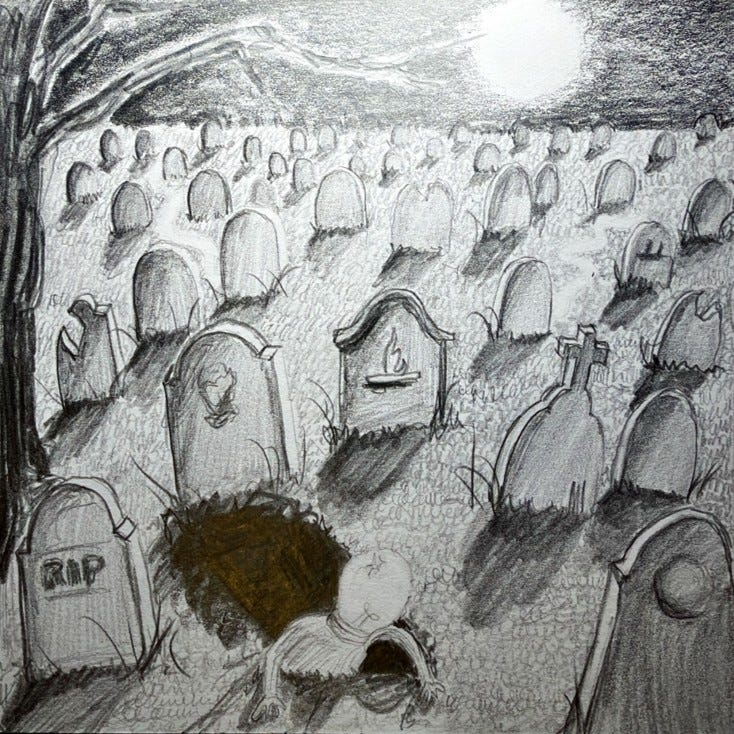
If the idea selection step isn’t better than chance, what are we trusting to ensure that they are of quality? Our experience, intuition, discernment? How do we gauge whether it isn’t the path of least resistance in disguise?
How do we trust that we’re making the right decision along the way?
That we’re not selecting an idea based on parameters, which, if exposed, might even appal us?
As much as I appreciate being cost-sensitive, I know that many of my creative decisions at work are heavily dependent on budget. An idea that could be so obviously better at solving a problem might never be pursued because it would require expansive out-of-scope work, or worse, would require me to rethink a brief and persuade stakeholders about the alternative. This annoyance and uncertainty often prevent me from redefining or engaging in any extra steps. I might open the door to it reluctantly, but then sigh in relief when it’s not given a chance to live.
Because it might then cost something of me.
But what is our personal and collective cost to sacrifice the potentially better idea in favour of convenience, ease, or lack of friction?
What might you find
if you were
to go grave-digging
in your idea cemetery?
.
..
…
When I asked myself this question, I expected to find frustrations for having given up ideas too lightly. I did find some, but I also found acceptance for having let go of those that were more than fine to bury. Those that were annoyingly naïve, that served my ego more than anything else, or that weren’t relevant anymore.
There were ghosts that lingered, too.
Those of ideas that never got a proper burial or been given their chance to live. As you might expect, they are pulling the strings, waiting for me to notice them and for the right moment to resurface in dramatic ways.
A Creativity Multiverse is one such ghost.
.
..
🕳️
Which idea do you refuse to take to your grave?
Until the next post
Notice how you evaluate and select your ideas and/or solutions.
Which ones head to the graveyard early? What might be the pattern behind their early demise?
Which ideas survive, not because they’re good, but because they’re convenient, easy?
If you dare:
Try giving one inconvenient idea a longer exploration time than it would usually get…
References
Rietzschel, E. F., et al. (2024). A systematic review of creativity evaluation and creativity selection measurement tasks. Psychology of Aesthetics, Creativity, and the Arts. Advance online publication. https://doi.org/10.1037/aca0000638.