

Rough drafts, risk, and relational creativity
When the process becomes the teacher (Part 3 of 3)


You can read this post, or listen to it, or both.
This is the last post of a 3-part series where you can peek into our process of clumsily holding a creative tension. If you’ve not already, we recommend you check out part 1 and part 2 before you continue.
An ongoing creative process can sometimes become a trial between collaborators. One that tests our patience, ability to bend, adapt and stay in the work. Are we able – or willing – to meet and handle its contradictions, sideways turns, and surprises?
That’s what the “speaking in rough draft” phrase challenged us to face. A single idea, that sparked a post, that sparked a near-collapse…and eventually a trilogy about what happens when we linger with what’s unfinished.
Part 1 invited us to speak before we’re ready.
Part 2 reacted to what can happen when that invitation is dangerous.
Part 3 is about what happened when we stayed inside that tension.
.
..
…
The first post and its response had sat for months.
Reviewed. Unresolved. Unpublished.
Both sides of the story felt right…equally true to us and valid in their respective contexts. So why were they festering in the draft folder?
Maybe the moment had passed.
Perhaps we were not re-entering the space because we didn’t know how to give voice to multiple truths. Or because we didn’t know how to fix it. Or because we were shirking doing the hard work of being in relationship where creativity meets friction, not flow.
But wasn’t this the very thing that we were advocating for? Holding steady even when it gets uncomfortable, shadowy, icky and tough…not only within ourselves but when co-creating with another person?
It would have been much easier to forget about it, label it as a failed experiment and delete it. The two perspectives were so far apart that no reasonable refinement of the original post could include both sides.
When we finally returned to it months later – tentatively, on a call – we realised that what we’d written, and the sitting with it, had left a tension between us. It had stirred something beyond two perspectives colliding that we couldn’t figure out how to join into one.
This difference in perspectives became the driver and mirror of our unfolding creative process. One where we name something, flinch when it lands differently than we intended, and then notice the tender places it touches in us and others.
While JS’ first instinct was to love the idea of speaking in rough draft, JS also remembered the rooms where speaking up felt like a public execution. JS also couldn’t fully sit with the idealistic idea that speaking in rough draft was often what’s most full of possibility – even if parts of him agreed.
And, when Val read JS’ impassioned response about the risk of doing the very thing she had evangelised, she felt first the truth of his argument. And next, the sting of her own naïveté. It wasn’t that she hadn’t felt the fallout of speaking in rough draft before—she had, many times over. It was just that a stretch of grace had let the memory fade. She had forgotten. And she was embarrassed.
It took a while for us to realise that what we were going through was somehow what we were trying to write about.
Letting an idea be received imperfectly (rough draft)
Letting a response challenge the original idea (risk)
Letting our mess be part of the making (unfinished drafts and tension)
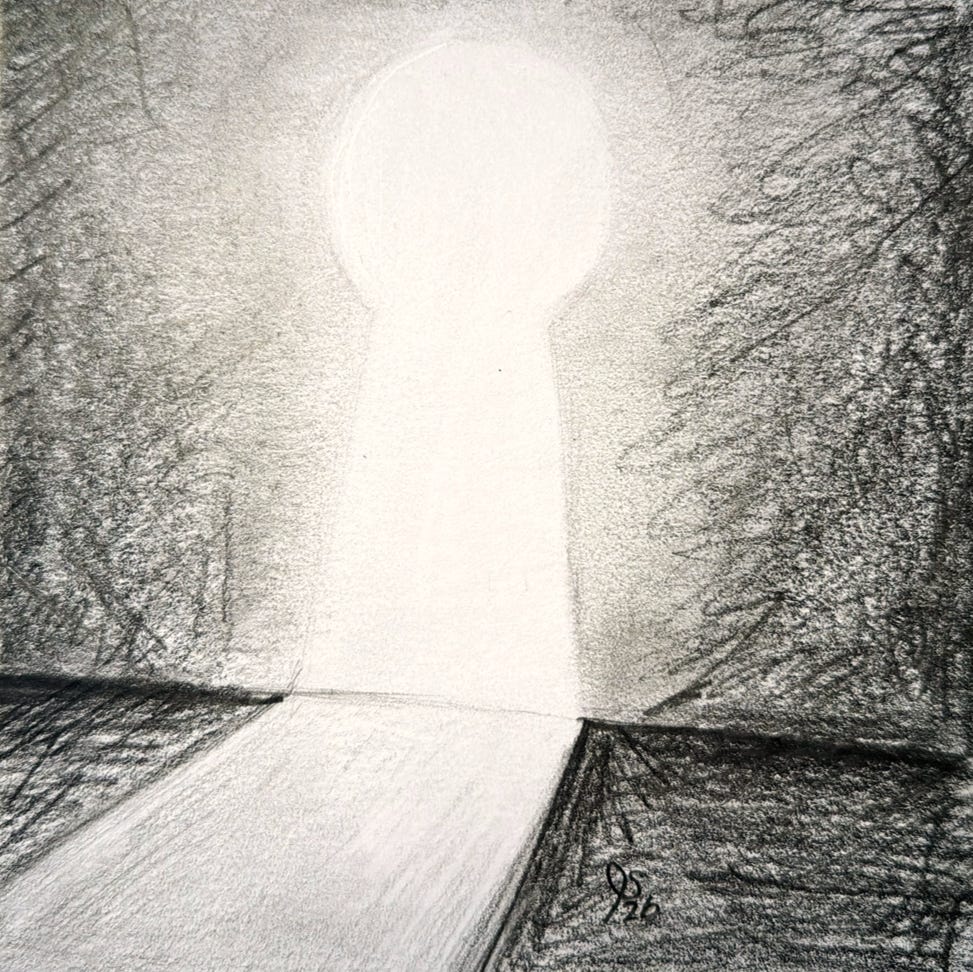
Letting the darkness linger before new light arrives (months of avoidance until it became this 3-part series)
The rough, the risk and tension, although seeming like obstacles at times, were also the path forward to a surprising third way.
A third way that wasn’t so much about choosing between the courage and risk of “rough draft” but rather that creativity lives in the relationship between the two.
In a sense, this trilogy became a field experiment.
What happens when we publish before we’re ready, before something is perfect?
What happens when someone else names what doesn’t land, and stays in the room?
What happens when two people keep turning toward each other, instead of resolving the tension too quickly or walking away from it?
We also noticed a pattern: offer, flinch, pause, and return.
A loop that neatly mirrors the creative process in action. The very texture of collaboration and relational meaning-making. What’s at the heart of human development.
It also helped clarify what A Creativity Multiverse stands for:
The creative process is the developmental process.
The way we respond to what’s hard is the art.
We are not here to perfect the thing, even if the pull to do so is very present.
We’re here to let it shape us.
.
..
…
This (perhaps!) concludes our 3-part series about how we learn as we encounter ourselves and our reactions through the emerging creative process.
We hope you won’t be shy in joining us in the exploration by sharing your reflection around the following questions and the invitation to experiment yourself.
Where in your life are you waiting for clarity instead of showing up honestly?
What becomes possible when the flinch isn’t the end of the conversation, but the beginning of another kind of seeing and learning?
How do you respond – to yourself or others – when something lands sideways?
What practices help you return, not to correctness, but to connection?
Until the next post
This week, notice a moment where something lands awkwardly, clumsily, or off-kilter, whether it’s something you’ve said, or something someone else offers you.
Instead of fixing or walking away, try this:
Stay.
Get curious.
Ask: What is this tension showing me about what matters here?
Want a more challenging version?
Let someone see your rough edges.
Say the thing that’s not quite finished.
Then, invite theirs, too.
See what emerges in the space between.